tasting taiwan
Published in the January-March 2010 issue.
It seems like an absurdly long way to go for lunch but our host, Ivy, is adamant: “You will understand Taiwan,” she says. After just a few days here, this cryptic statement makes perfect sense to me.
There are various ways to experience the zeitgeist of a culture: through its youth, its media, its malls. In Taiwan, it’s through the food. Every dining experience here seems to have an accompanying story that reveals a little more about the character of the beautiful island.
We’ve fast-tracked from the capital Taipei and are in the heart of Taiwan, surrounded by vivid green mountains. We pass girls encased in Plexiglass boxes, wearing little more than bikinis. These are betel-nut sellers and young, modern Ivy is dismissive: “That’s old Taiwan,” she says.

Today’s Taiwanese are far more health-conscious and “natural”, according to our host, and it is nature we’ve come to experience. Puli is famous for its wine, water, weather and women – all of which are fair and abundant. The pristine environment is heavily protected and we pass greenhouses and hothouses amid fields of super-charged fruit and vegetables. Volcanic soil and a temperate climate make this the green belt of Taiwan and all ingredients from here are highly prized – especially its flowers.
Today, we dine on a flower banquet at Pu-Li Restaurant. The meal includes chrysanthemums in pork jelly; tempura flowers of pumpkin, melon and ginger; and fatty pork belly with sugarcane and the tender hearts of bamboo known as ‘beautiful legs’. The soup is a lilypond with fluorescent ferns and tiny fish, and we say ganbei (cheers) with a glass of fiery Shao Hsing rice wine made just down the road. The food is perfectly balanced and delicately flavoured to allow the tastes of the flowers themselves to shine through.
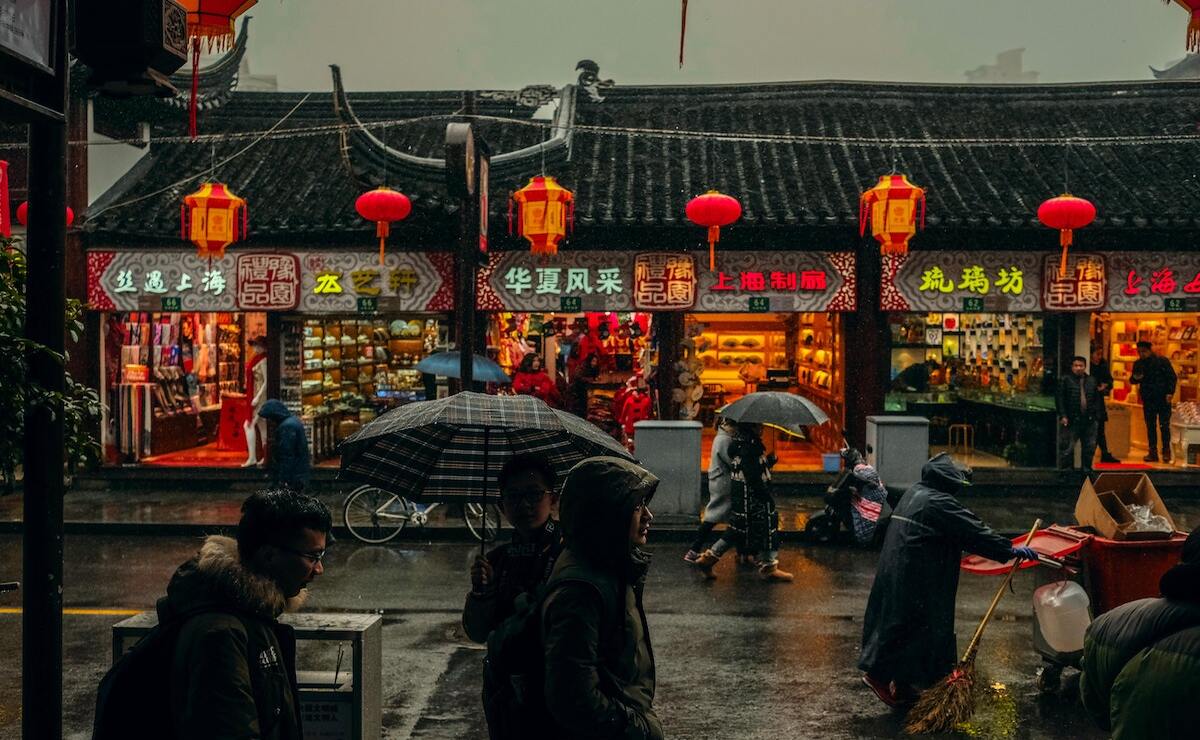
My introduction to the food of Taiwan began in downtown Taipei on a weekday at lunchtime. It was mayhem. The streets were heaving with mostly young, hip and busylooking professionals seeking their midday meals. We passed noodle bars, hole-in-the-wall eateries, dumpling houses and mountains of street food to reach Dou Hsiao Yuan restaurant, a modern building with a wooden facade and a sign of dubious accuracy reading ‘established 1895’.

Apparently in 1895, an enterprising fisherman created a cheap, filling meal of beef noodles and hung a lantern outside his stall advertising dou hsiao yuan – ‘slack season noodles’. Dou Hsiao Yuan restaurant is one of many establishments offering this style of noodle. They’re hugely popular among the Taiwanese, who value simplicity and tradition and are determined not to forget their humble beginnings.
The restaurant is busy but Ivy talks us in. Just inside the doorway is a replica of the original fisherman’s stall, where cooks squat by a brick stove doling out fragrant noodles with minced beef and fresh coriander. They’re served with eggs boiled in soy sauce and side dishes of salt-and-pepper oysters, cold ‘city oil’ chicken, braised pigs’ trotters and green vegetables.
After Portuguese and Dutch rule; after the wave of migrants from China’s Fujian province and the Hakka people; after the Japanese retreated following their World War II losses, the next major influence on Taiwan and its cuisine was the retreating Nationalist Chinese. Leaving Mao Zedong to rule the peasants on the mainland, Kuomintang leader Chiang Kai-shek crossed the straits, bringing with him middle- and upper-class people from all over China – and their private chefs. As a result, Taiwan became a veritable buffet of the best mainland specialities. Shanghai and Beijing dishes are done particularly well and tonight, we’re dining on the mainland capital’s eponymous duck.

Provenance is important to the Taiwanese, and Chef Lam Yau Chang from the Sherwood Hotel allows guests to tag along as he visits the morning food market. He leads us to his favourite poultry provider, pointing out the gruesome machines that slaughter, drain, then de-feather your selected bird. Back at the hotel kitchen, we’re allowed backstage to see how Beijing duck is stuffed, marinated, hung for 10 hours, then smoked before being wheeled into the Yi Yuan dining room.
The duck forms part of an elaborate banquet, on par with Beijing’s finest. For a world-class dining experience, order the ‘Former President Bush Banquet’, featuring abalone, shark-fin soup, caviar and lobster.
As well as traditional meals, Western-influenced food and fine dining have become popular in Taiwan, though modern Taiwanese haute cuisine might better be described as ‘refined dining’. Nowhere is this better presented than at Shi-Yang Culture Restaurant at Yangmingshan Mountain, just outside Taipiei. There’s no menu, no alcohol and you have to book three months in advance, but it’s all part of the experience. Seeming a million miles from the city below, Shi Yang is the mountain retreat of former architect Lin Bing-Hui, a devout Buddhist who believes eating should be a holistic experience. Everything about the place, from the dim lighting and the position of a lone orchid, to the food, environment and muted twang of an erhu, is designed to impart health and serenity. Guests sit in Tang dynasty style private rooms open to the pine forest and cool night air. We wash away the city with an appetiser of mango juice and passionfruit; then almond silken tofu, a spring roll with durian, scallops and steamed egg white – incredibly light and full of flavour – and salt-fishstuffed tofu pouches. Sharp, sweet fruit vinegar is served between courses to point our palates in the right direction – in my case, a sashimi plate that’s an adventure in flavours and textures. Lin creates all the dishes himself, using his scientific mind and Zen principles to come up with inspired creations such as fried soup. The meal takes three hours and is followed by a tea ceremony.
The following day, we meet another soul for whom food, life and art are one. Hsieh Li-Hsiang built her first restaurant 16 years ago using driftwood, oyster shells and fallen trees. A farmer’s daughter with limited education and resources, Hsieh epitomises the industrious and creative spirit one finds so often in Taiwan. Today, there are four Five-Dime Driftwood House restaurants. The one we visit is in Taichung city. Hsieh has created everything, from the Gaudiesque buildings to the tables, plates and dishes. The meal is chaotic, in an exciting, unrestricted way. On the first plate is a salad in a peanut dressing, accompanied by a cheese straw, berries and mashed potato. We wash it down with a mango lassi, served in a heavy clay cup. Somehow, it works. Shark-fin soup and scallops with mayonnaise, fried rice with seaweed and asparagus, East, West – anything goes. Public opinion is divided over Hsieh’s creations. She has no formal training, which goes against traditional Chinese culture, but her architecture is sound and her restaurants very popular.
Later, visiting the riverside town of Danshuei on the outskirts of Taipei, we get to see Taiwanese of all ages doing what they love best: eating and drinking. Ivy leads us towards the local speciality, A-gei Restaurant (which simply means ‘tofu’). The tile-and- brick, open-fronted restaurant is heaving and our meal is fast, furious and loud. We cram onto one of the communal benches beneath a shrieking restaurateur and dig into tofu pouches stuffed with mung-bean noodles, served in a broth and doused in spicy sauce. The traditional accompaniment is fish-ball soup, which has a lovely cinnamon and five-spice flavour. Like every meal I’ve had in Taiwan, it is delicious, healthy and fresh. •
Photography by Jo Hegarty.
TRAVEL FACTS
getting there
getting around
where to stay
where to eat
- Pu-Li Restaurant, 236 Xinyi Road, Pu Li, phone +886 49 299 5096 or visit www.puli-eating.com.tw
- Dou Hsiao Yuan, East Road, Chuan Shio, Taipei, phone +886 2 2773 1244 .
- Yi Yuan Chinese Restaurant, The Sherwood Taipei, 111 Min Sheng East Road, Section 3, Taipei, phone +886 2 2718 1188 or visit www.sherwood.com.tw
- Shi-Yang Culture Restaurant (Shan Fang), 160, Lane 101, Jingshan Road, Shilin District, Taipei, phone +886 2 2862 0078 or visit www.shi-yang.com
- Five-Dime Driftwood House Restaurant, 6 Fuhwei 1 Street, Shitun District, Taichung City or 8 Lane 32, Section 1, Neihu Road, Taipei, phone, +886 2 8501 1472 or visit www.five-dime.com.tw
further information
|