It's more fun in the Philippines
Win a fabulous four night vacation in Bali!


misty river

By Kate Armstrong.
Published in the January-March 2012 issue.

The Three Gorges Dam may be one of the most controversial engineering projects of recent history but it has opened China's most important waterway to a new wave of cruise tourism.


I’m perplexed at being ordered to point my camera upwards to photograph what appears to be nothing more than a rock face. “You’ll see what it is later,” our guide Jamie assures me, gesturing at the sheer cliffs and urging me to shoot. I’m dubious but decide that Jamie probably knows this tributary of the Yangtze River better than I do, so I aim my lens at the muddy precipice and press the shutter button.
Sure enough, when the image is enlarged, I’m stunned. I’m staring at an historical treasure: a coffin more than 2,000 years old, wedged into a vertical cliff face hundreds of metres above us. How the ancient Ba people manoeuvred these “hanging coffins” – thought to date back to the Warring States Period (475–221 B.C.) – into position remains a mystery. And, as I fast discover, it’s just one of many surprises awaiting me on my cruise along the Yangtze.
China’s longest river and the third-longest in the world, the Yangtze is perhaps best known for its massive Three Gorges Dam project, a remarkable engineering feat. Our ship, Victoria Katarina, is heading upstream (east to west), covering some 660 kilometres between the cities of Yichang and Chongqing, taking in the Three Gorges – Xiling, Wu and Qutang – and their associated dam along the way.


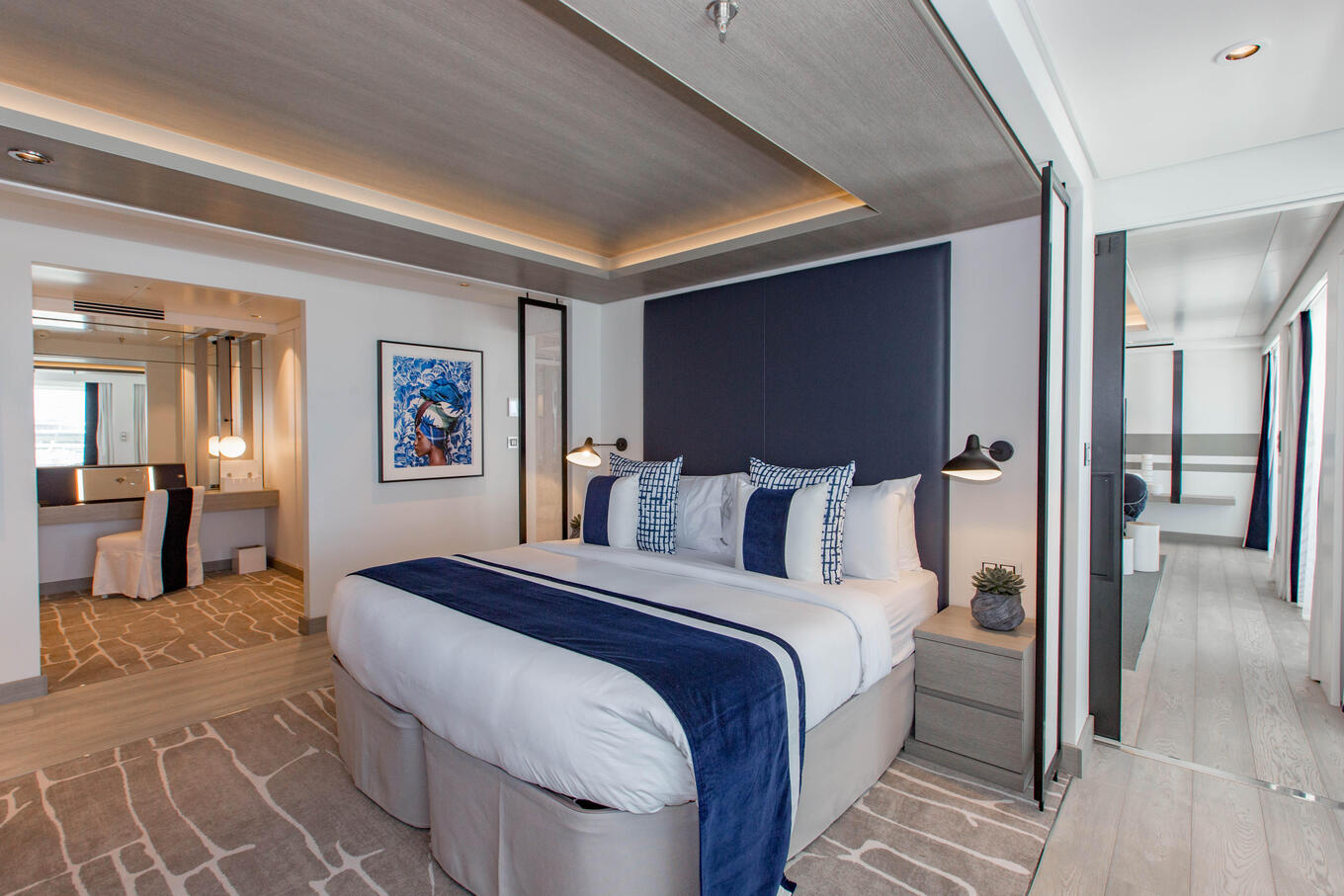
Katarina is my home for the next four nights. She has 132 cabins and mine is an executive suite, superior in size to a regular two-bed berth, with plain but pleasant décor, extra living space and a balcony. As we set out from Yichang, I soak up the view from my balcony – mist envelops the riverbank, the chocolate-coloured water is littered with twigs, and large barges pass by laden with coal and sand.

We float past farmers’ houses – small white buildings with pointed roofs – set on terraced hillsides. Factories are dotted here and there, their chimneystacks spewing smoke. Several bridges span the riverbanks: the onboard commentary highlights these “attractions” – testament to China’s construction and development boom – especially the more contemporary cable bridges. Guests gather on the deck to take photos, jumping when the ship horn blasts.

Our first morning on the river brings a trip highlight: a visit to the dam itself, located on Zhongbaodao Island in the Xiling Gorge. At the site entrance, we queue behind hundreds of other people to pass through the airport-style security; we’re told that around 1.4 million tourists, most of them Chinese, visit the dam every year. Brightly coloured tour-company flags, signs and matching baseball caps ensure travellers don’t stray far from their guides.

Our group formed, we make our way to the dam’s lofty viewpoints. We look out over the locks – neat lines of concrete, pipes and turbines spread out before us. Some locals refer to the site as a “special gift from God.” I wouldn’t go that far, but the world’s largest dam and hydroelectric plant is impressive.

Construction of the dam began in 1994 with the overriding goal of alleviating flooding through China’s industrial heartland – tragically, major floods killed more than 300,000 people in the Yangtze River valley over the 20th century (140,000 died when a dyke broke in 1931) – as well as improving navigation and generating hydropower. “Clean power, low pollution: so good for the environment!” sing out the guides who show us around the site.

More controversially, the dam’s creation meant forcibly relocating 1.3 million locals to new cities, towns and coal-producing regions as massive areas of farmland, villages and cities were submerged – by 2020, it’s estimated that some 5.3-million people will have been relocated.

Dam statistics pour from our guide like water from the massive sluice gates below, gates that are closed during our visit. The one that sticks in my memory is that around 200 vessels can pass through the five-step locks every day. The process can take up to four hours, during which time the boat may rise or drop a mindblowing 110 metres.

We return to our boat, excited to be entering the first lock and the Three Gorges. Unfortunately, night falls quickly and it’s dinnertime as we hit the deck, so – as our host jokes – we miss the spectacle of being “locked up” (warning: dam humour dominates onboard conversations).

After dinner, we hit the bar to watch the evening’s entertainment: multi-talented crew members treat guests to cultural performances of some of China’s 56 ethnic groups.


It doesn’t take long to fall into a daily routine: pre-breakfast tai chi with Dr. Li, the resident doctor; a buffet breakfast; land excursions to ancient sites; and, one day, to a local market, where we wander among stalls piled with everything from pickled vegetables and ducks’ heads to “century eggs” – duck, chicken or quail eggs preserved in a mixture of clay, ash, salt and lime for several weeks. Vendors sit on small stools, arranging apples into neat piles or weighing their fare on hanging scales. Elderly women knit and gossip and several men stroll by in blue Mao suits – attire made famous by China’s Great Helmsman. Then it’s back to the boat for lunch followed by cultural “lessons” that range from Chinese language to mahjong.

The boat makes fast progress. Now and then, cities and towns loom up from the mist like massive grey cardboard dioramas from a dated Hollywood set. From our position on the river, these appear strangely one-dimensional, and there are few signs of life. Perhaps it has something to do with the absence of brightly hued billboards – commercialism hasn’t hit these remote riverside towns yet. It’s a different story in Chongqing, our final cruise destination.

Other experiences are more colourful, such as my reflexology massage in the boat’s small spa. The zealous practitioner kneads out my knots and, as I hobble away, she reminds me, in perfect English: “No pain, no gain!”

Gain I do, if only around the waist. Meals in the executive dining room are generous, if disappointingly westernised. Downstairs, the main dining hall is abuzz with chatter and the clatter of chopsticks as hundreds of guests – Chinese and foreign – tackle platters of noodles and dumplings. On the final night of our journey, all guests are invited to a banquet – a delicious array of regional and fusion dishes.

On our third day, Katarina docks at “new” Wushan, a town of some 100,000 residents, the majority of whom were relocated to higher ground after “old” Wushan was submerged. We transfer to a ferry, then a motorised sampan, and meander along a Yangtze tributary, the Daning River, and through the Lesser Three Gorges: Dragon-Gate, Misty and Emerald. Visitors who came here before the dam’s construction don’t recognise the place. Former rapids are now deep, emerald-hued waters, and the river is wider – or, as our guides repeat, “The mountains are smaller.”


Long gone are the “boat trackers” – men who were once employed in backbreaking labour pulling boats along the one-time shallow waters (the practice was largely stopped in the 1970s).

We cruise for kilometres up the tributary, passing fields of cypress trees planted as part of the government’s Yangtze River valley reforestation efforts. We reach Misty Gorge, China’s answer to Halong Bay in Vietnam, where low-hanging cloud clings to green mountains and sheer cliffs, rocks and caves. Stalactites appear at eye level; we even spot monkeys playing on a rocky outcrop. It’s here that Jamie orders me to snap blindly at the extraordinary hanging coffins, a testament to the region’s rich history and culture.

I don’t see any fish but I’m assured that many species have been introduced to the river in recent years. Unsurprisingly, the dam’s construction had a detrimental effect on several Yangtze River-dwelling species, including the Yangtze sturgeon and the finless porpoise, whose numbers are dwindling rapidly. The freshwater baiqi (Yangtze River dolphin) is now extinct, and two frail, zoo-bound Yangtze giant soft shell turtles are thought to be the last on earth. Meanwhile, resident populations of the Chinese alligator and Chinese giant salamander are critically endangered.

Unfortunately, during our trip, downpours bring floods to another Yangtze tributary, upstream: the Jialing River, above which stands the city of Chongqing. We suspect something is not quite right – the Yangtze is murky and the water, moving rapidly now, carries an unusual amount of flotsam and jetsam. Two other cruise ships are prohibited from heading downstream; we remain docked, our final night’s journey under threat.

Later, at dinner, our captain enters the dining room to meet and greet guests. The lazy Susan in the middle of our table starts spinning wildly and Katarina begins to rock like an ocean liner in a storm. Then, the announcement: “It’s dark outside and the current is running very hard, so the captain must go back to the bridge.” We’re lucky, our guide tells us, we’ll be able to continue our journey into the night.

In my cabin, I unfold my life jacket and place it strategically on my bed – I’m worried I won’t sleep. But the ship’s swaying and patter of rain lull me to sleep with only the thought of the misty banks of Chongqing on my mind. •

Photography by Kate Armstrong and courtesy 
of Helen Wong’s Tours.


TRAVEL FACTS

getting there
China Southern Airlines has direct flights to Guangzhou from Sydney, Melbourne, Perth and Brisbane and domestic flights from Guangzhou to Yichang and Chongqing (for Yangtze cruises). 1300-889-628; flychinasouthern.com

getting around
Various group tours with China travel specialist Helen Wong’s Tours, such as the 13-day “Yangtze Wonders” trip and the 18-day “Mighty Yangtze” package, include Victoria Cruises’ Yangtze sailings. Helen Wong’s Tours can also organise independent trips around Guangzhou. 1300-788-328; helenwongstours.com

when to go
The best, albeit busiest, times to cruise the Yangtze are during the months of April, May, September and October. Avoid November through February, which can be bitterly cold.

where to stay
Before your cruise, check in to the new, Parisian-themed Sofitel Guangzhou Sunrich in China’s southern city of Guangzhou. The Sofitel Forebase Chongqing makes for a comfortable base when you alight in Chongqing. sofitel.com

further information
Contact the China National Tourist Office for additional information on travelling around China. cnto.org.au

Hyatt Regency - the perfect escape
Get our latest newsletter
Sign up today to receive travel tips, the latest travel news & exclusive competitions, straight to your inbox!


V&T Takeoff
Updates from our editors and writers
The team from the Dallas Convention and Visitors Bureau were in town last week to update Australia on some of the BIG things happening in the Texan state.
V&T mag dropped into Bali last month and helped the W Retreat & Spa celebrate their 2nd anniversary and what a splash it was. With local and international fashion designers on display, the W Lounge was transformed into a catwalk party zone. 2500 people flowed through the resort late into the night, moving to NYC DJ Sandy Rivera. This was the biggest ticket in Bali for some time and the resorts pulling power is a testament to just how hot this property and international hotel brand actually is.www.vacationsandtravelmag.com/Mca/874/765/3/0/0/#takeoff1 How did we cope the next day? Poolside. Don’t wait until their 3rd anniversary as the vibe, sound and style of this resort makes for a very cool holiday. In the heart of Seminyak and right on the beach, Bali beckons.
Thanks to our friends at Air France we got out of the office for the day and enjoyed a great round of golf at the annual Financial Markets Charity Golf Day and Gala Dinner. Held annually in February, this event as well as the  Financial and Media Markets Charity Sailing Regatta in October raises AU$1.2 million for a wide range of charities.The ASX Group and Thomson Reuters Australia (formerly Reuters) joined forces in 1999 to form a Charity Foundation with the objective of helping Australian-based children, disability and medical research charities by organising fundraising events in conjunction with the Financial Markets. Pictured here: Thomas Reeves Air France, Middle, Patrick Benhamou, Atout France; Anthony Gallagher Vacations & Travel magazine.
Vacations & Travel magazine rubbed shoulders with local and international buyers and sellers of travel from around the globe at 2013 AIME (Asia Pacific's Incentive Meeting Expo). This is the biggest event on the Australian travel industry calendar, where key decision makers congregate to network over a three-day event of hosted parties, trade and leisure travel meetings and press conferences.
The who's who of Sydney's entertainment industry turned up for the recent opening of the city's newest hotel to receive a makeover, The Parkroyal. Located in Darling Harbour, the property has just emerged from a milt million-dollar makeover to reveal striking rooms and seriously sexy public spaces. Speaking of sexy, some of the celebs on hand to celebrate the re-launch included Casey Burgess, Danielle Blakey and Amy Milne, not to mention Timomatic who entertained the crowds into the witching hours…


about us advertise subscribe & win contact us Golf Vacations